

In the first half of 2026, Geely Automobile's total sales reached 1.423 million vehicles, a year-on-year increase of 1%. Looking at the numbers alone, the growth rate is not particularly striking, but when broken down by structure, changes have already taken place. The proportion of new energy vehicle sales exceeded 56% for the first time, reaching 799,500 units, with plug-in hybrid models surging 57.7% year-on-year; overseas exports totaled 474,200 units, a sharp increase of 158% year-on-year, with new energy models accounting for nearly 60% of that.

Behind the data is a clear logic: Geely did not choose to trade scale for growth, but instead used product structure upgrading and global layout to increase the value of every vehicle. This confidence ultimately landed at the August 28 launch event, where Geely's AI new energy off-road technology was officially unveiled, and the first model to feature it, the Galaxy Battleship 700, also entered the public eye. The question it aims to answer is straightforward: when new energy penetration stands firmly above 50%, can hardcore off-roading, traditionally a "professional track," truly be restructured?

A thousand horsepower is only the starting point; precise output is the core
The high-spec version of the Galaxy Battleship 700 is equipped with a 2.0T engine + three-motor four-wheel drive, with a combined system power of 830kW, peak wheel-end torque of 13,920N·m, and a 0-100km/h acceleration of 3.95 seconds. The numbers are fierce enough, but what truly matters to off-road veterans is how this power is "used."
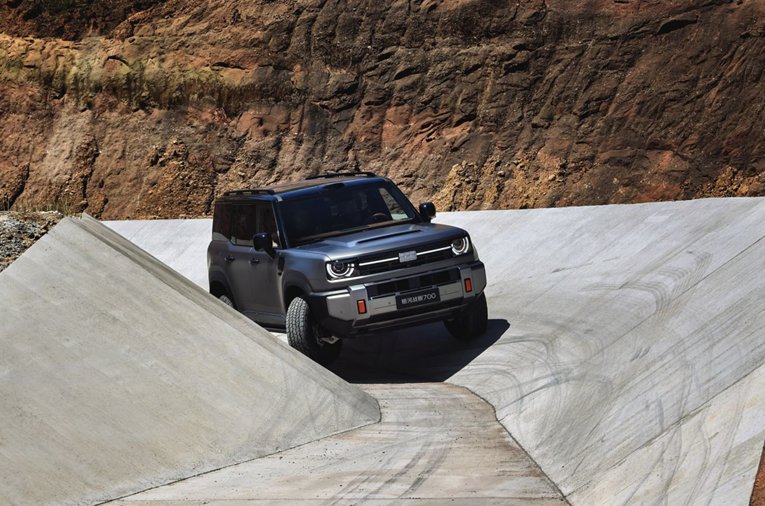
The Thor EM-T system adopts a three-motor decoupled layout with a front P3 motor + rear dual P4 wheel-side motors, allowing independent torque control of the left and right rear wheels. Paired with two electronically controlled "soft locks" and one rear axle mechanical hard lock, the electric drive can complete the closed loop from slip detection to torque output within 2 milliseconds, adjusting 500 times per second. This means that before wheel slip even has a chance to occur, torque has already been redistributed.

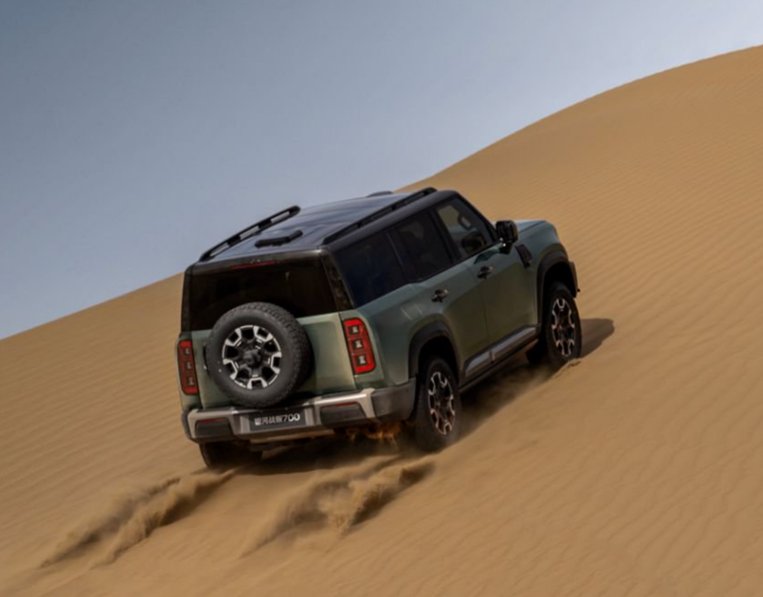
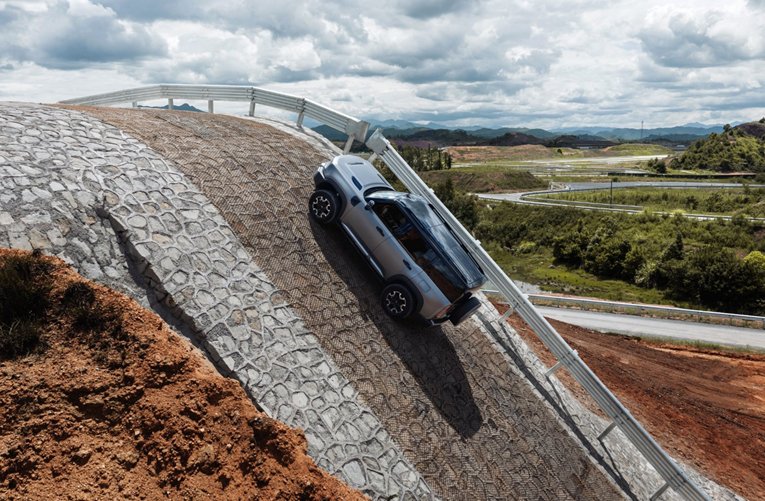
In the Badain Jaran Desert's Nisan Pot, where the slope exceeds 100% and the drop is about 120 meters, the Galaxy Battleship 700 successfully climbed directly from a standstill at full load. The significance of the test itself is that it verified the torque control logic of electric-drive off-roading under extreme conditions is viable.
The GTA architecture has forged its own path
This vehicle adopts a unibody ladder frame structure. Although it follows the same approach as the Land Rover Defender, Geely has done several things on top of this: a 6-horizontal, 7-vertical, 8-ring integrated cage body with torsional rigidity exceeding 40,000N·m/deg, and a roof capable of withstanding 16 tons of load; compared to traditional decoupled ladder frames, it saves 100 kilograms, with the entire vehicle reducing weight by 200 kilograms.
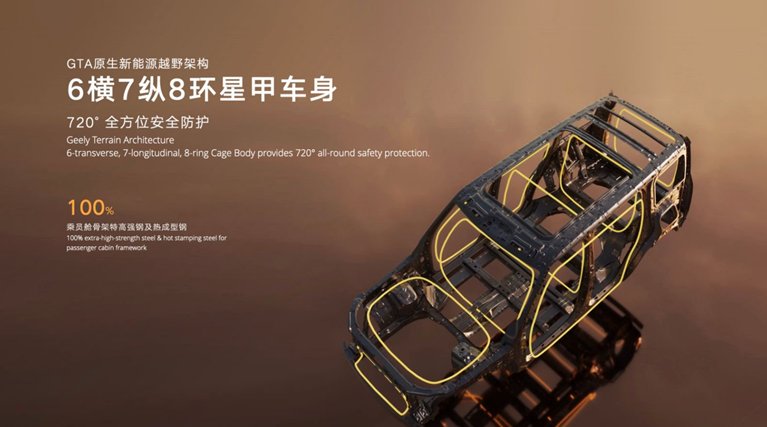
The ingenuity of this architecture lies in its "embedding" — the ladder frame is fully embedded into the body skeleton, preserving the torsional rigidity of a body-on-frame structure while freeing up vertical chassis space, achieving an interior space utilization rate of 80.3%. The flat threshold + 80° rear door opening angle provide ease of entry and exit rarely seen in traditional hardcore off-road vehicles.
AI all-terrain blurs the line between novices and veterans
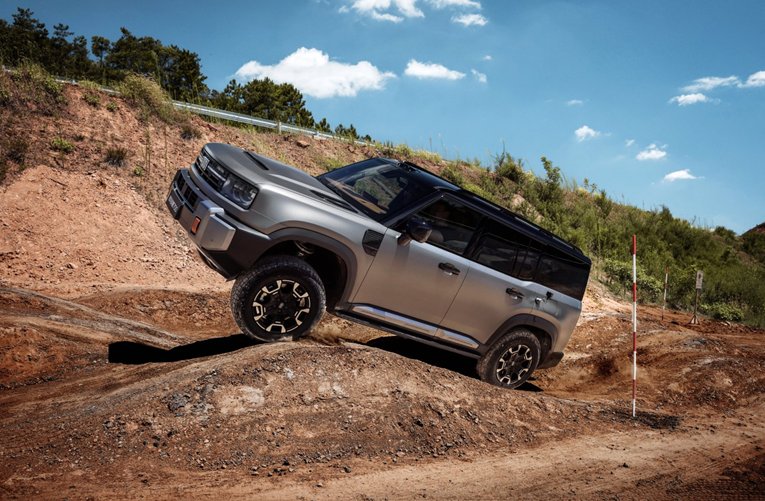
The GVMC3.0 vehicle control hub + EEA4.0 electronic and electrical architecture form the "brain" of this vehicle's "AI all-terrain" capability. Cameras and radar can identify road conditions 30 meters ahead in advance, automatically matching modes such as sand, mud, and rock, and adjusting torque distribution and suspension status in real time.

The Waltz turn function provides a 3.36-meter turning diameter, allowing U-turns even in narrow sections or dead-end roads; in intelligent climb mode, the vehicle outputs maximum traction at 2-15km/h, with differential locks automatically engaging and suspension rising to the highest level, leaving cross-axle and steep slopes to the system. This logic is clear: turning off-roading from "experience-driven" to "algorithm-driven," allowing more people to venture out safely.
Comfort is not a compromise, but another kind of competitiveness
The Galaxy Battleship 700 attempts to claw back the comfort sacrifices of traditional hardcore off-road vehicles. An 18.5L dual-opening heating and cooling fridge, a 1.8-meter rear flat-folding bed, a 23-speaker Flyme Sound audio system, and front seats with ventilation, heating, and massage — these features would be reasonable on a luxury SUV, but appearing on a ladder-frame off-road vehicle shows that the direction of product definition has changed.

The safety aspect is equally noteworthy. The battery pack features a recessed design with ground clearance of 313-403mm, and the bottom has 6 layers of protection including polyurea bulletproof coating, "impenetrable by a .22 caliber bullet"; wading beyond 800mm automatically activates emergency flotation mode, with sonar detection of underwater obstacles + rear thrusters, staying afloat for 40 minutes; relying on Geely's 64 low-orbit satellites, two-way communication is possible even in areas without signal.

The confidence behind the validation
At this launch event, Geely simultaneously announced its "User-First Global Quality Validation System." The Galaxy Battleship 700 had a development cycle exceeding 3 years, with 859 test vehicles deployed, cumulative validation mileage of 6.11 million kilometers, covering over 80 off-road scenarios and 7,933 standard validations. The Shangrao test base — Geely Global Test Site No. 2 — features 180 types of typical special road surfaces and a total test road length of 75 kilometers.

At a time when the industry generally pursues rapid iteration and shortened testing cycles, Geely's stance on this validation system is direct: no rush-built cars, and users will not be test drivers.
Daxia's Car Talk
From the 1.423 million first-half sales to this technology launch event, what Geely has delivered is an answer to "how to do it." The significance of the Galaxy Battleship 700 is not whether it will be the next blockbuster, but that for the first time it turns "hardcore off-roading" from an exclusive label of professional players into a replicable, popularizable technical solution. And Geely's continuous optimization of its sales structure precisely confirms that this "no compromise, no settling" strategy is being accepted by the market. Pricing and post-delivery reputation still need time to be tested, but at least the new energy off-road track now has one more option worth taking seriously.


