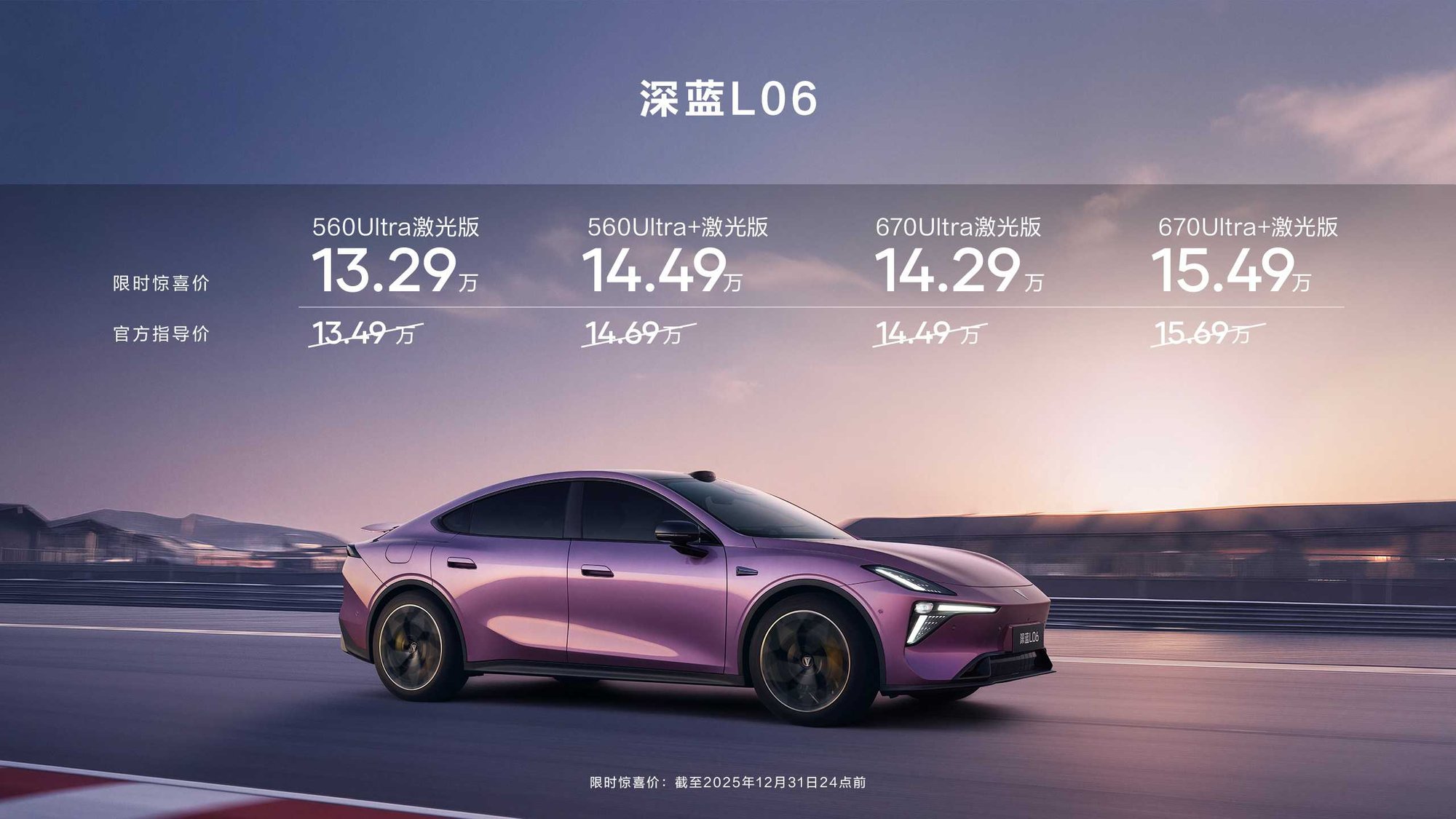
On November 18, the Deepal L06 was officially launched, with 4 models, an official guide price of 134,900–156,900 yuan, and a limited-time surprise price of 132,900–154,900 yuan. By conventional understanding, this should be the price range of a "volume-selling family electric sedan," but what Deepal has piled onto this car is a bit unconventional—
lidar as standard across the entire lineup, a 3nm automotive-grade cockpit chip, fourth-generation MagneRide® magnetorheological active suspension, and a moose test top speed of 85.6km/h.
If summarized in one sentence: this is a pure electric sedan built mechanically and chassis-wise like a sporty mid-size car, but priced like a family car.
1. A mid-size pure electric car in the 130,000 yuan class, with very "unconventional" pricing
The official price structure is as follows:
560 Ultra Laser Edition: 134,900 yuan (limited-time 132,900 yuan)
670 Ultra Laser Edition: 144,900 yuan (limited-time 142,900 yuan)
560 Ultra+ Laser Edition: 146,900 yuan (limited-time 144,900 yuan)
670 Ultra+ Laser Edition: 156,900 yuan (limited-time 154,900 yuan)
On paper, there are two key pieces of information:
The body class is mid-size—the L06 is 4830mm long with a 2900mm wheelbase, which is already the size of a traditional B-segment sedan, yet the starting price still remains in the range of many compact electric sedans.
The configuration gradient does not use "strategic cuts"—lidar is standard across the entire lineup, and core hardware such as the suspension and cockpit chip is not just "given to the top trim as a token gesture," but spread across the whole model line.
Add to that up to 78,760 yuan in comprehensive car purchase benefits, as well as reassuring terms such as "for orders locked before November 30, if delivery crosses into the next year for reasons not attributable to the customer, Deepal will bear the purchase tax difference," which essentially helps you lock in part of your purchase cost expectations—for people planning to get into a pure electric car this year, this is actually quite practical.
2. Design: not flashy, but a kind of sportiness that "lowers the stance"
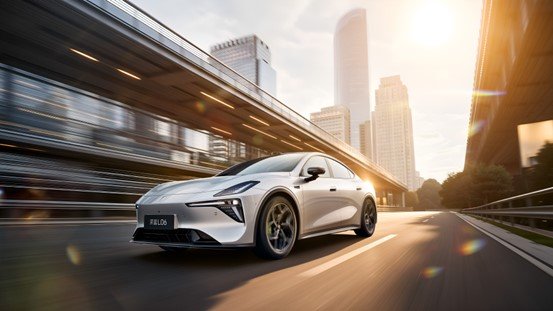
From exterior to proportions, the L06 follows a sporty mid-size electric sedan route.
Front face: Deepal's latest family design language, with a very clean upper section and not too many complex lines; raised creases on both sides give the front hood a bit of "muscle," not in a fierce way, but with a somewhat "taut feeling like a running shoe."
Lighting: officially inspired by "cold orchids and ice crystals," ultimately presenting a light shape resembling blooming petals. The advantage is that it is memorable enough—among a bunch of "slim daytime running lights," you know it is this car at a glance.
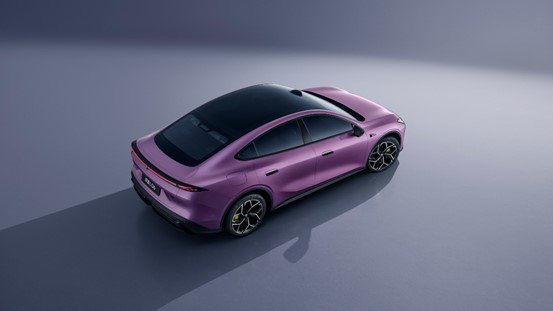
Side profile: the overall stance is relatively low, with the window line pressing down and the roofline slightly fastback, and together with the 4830mm length and 1905mm width, it looks more like a "coupe-like" mid-size car rather than a traditional family three-box sedan. The rearview mirrors sit above the door panels, which to some extent helps optimize wind noise and visibility.
Rear: a small ducktail + large diffuser, with the brand logo embedded in the middle of the through-type taillight. The treatment of the entire rear leans more toward an expression of "performance feel," not a dignified route.
If you usually dislike the imbalanced proportions of "ICE-to-EV conversions," then in static appearance this car feels closer to a mid-size car whose proportions were redone for a pure electric platform.
3. The chassis is the car's biggest highlight: magnetorheological + 85.6km/h moose test
The place where Deepal "spends money most unconventionally" on the L06 is actually not the infotainment system, but the chassis.
Fourth-generation MagneRide® magnetorheological active suspension
This is the fourth-generation system developed by Jingxi Zhixing, whose core is achieving millisecond-level adjustment of suspension damping through variable magnetoresistive fluid + electronically controlled valves. Simply put:
When driving over manhole covers and fine bumps, the damping becomes softer, improving comfort;
During aggressive lane changes and emergency avoidance, the damping instantly becomes stiffer, suppressing body roll and improving support.
In the 130,000–150,000 yuan price range, many cars do not even have ordinary adaptive suspension, let alone magnetorheological.
Moose test 85.6km/h
The result announced by CATARC is: the maximum passing speed reaches 85.6km/h. In actual comparisons, the 70-plus km/h range is the conventional level of many family SUVs/sedans, above 80km/h already belongs to the "good dynamic limit" category, and above 85km/h, it starts to have the flavor of a "sports car."
For ordinary users, this result is not encouragement to recklessly change lanes at high speed, but rather shows that:
under the same emergency avoidance situation, the body attitude and stability margin it gives you will be a bit greater.
If you usually drive a lot on highways and care more about "whether the body follows your hands" and "whether lane changes are stable," the chassis hardware of the L06 is worth a dedicated test drive.
4. Intelligent hardware: lidar + 3nm chip + 50-inch AR-HUD
The L06 has three keywords in intelligent configuration:
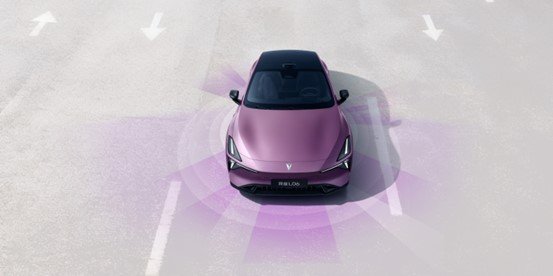
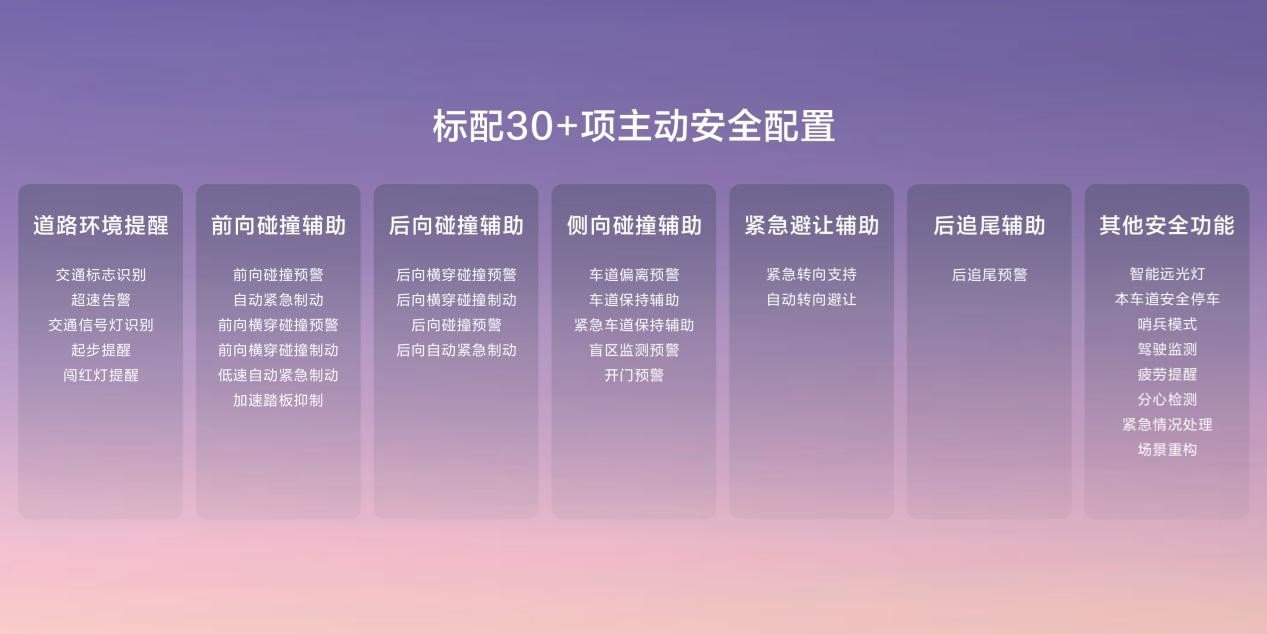
Lidar as standard across the entire lineup
In the 130,000 yuan class, lidar is still far from being "standard"; many cars either do not have it, or only symbolically include one on the top trim. The L06 makes it standard across the whole lineup, which means first raising the vehicle's perception "ceiling" relatively high.
As for exactly how much high-level intelligent driving capability can be achieved, that depends on subsequent software strategy and the pace of city rollout, but from the perspective of hardware investment, it is prepared for "long-term capability."
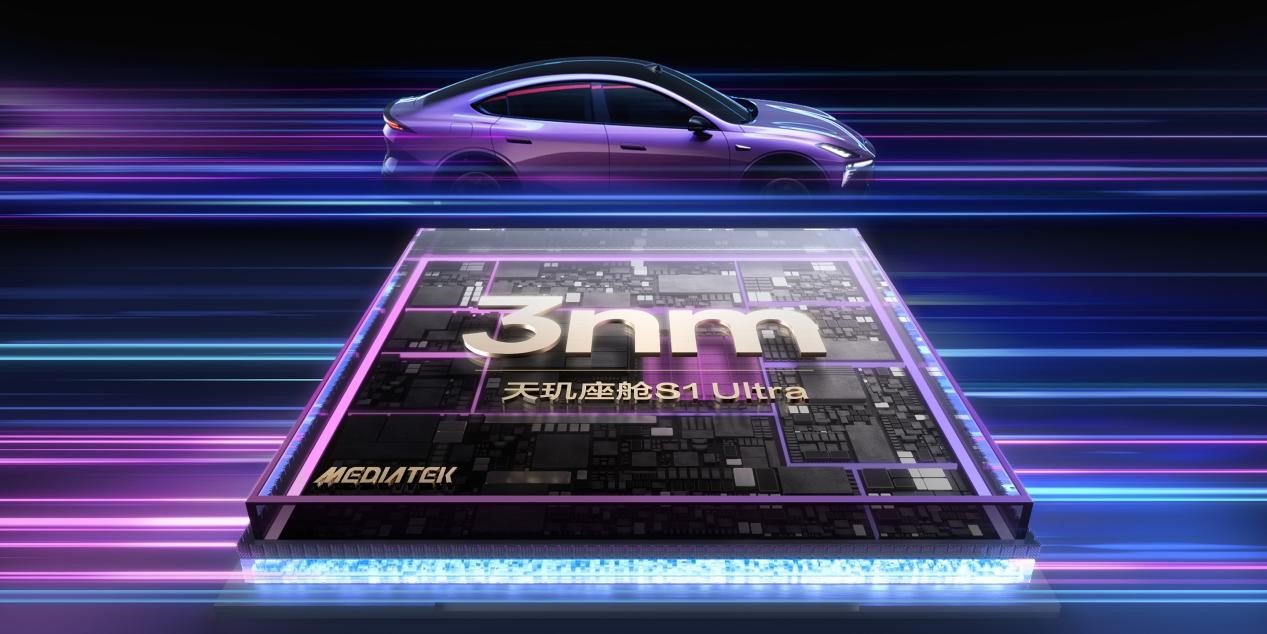
3nm automotive-grade cockpit chip
The 3nm process itself means higher computing power and lower power consumption. The direct feelings for owners are:
interface switching is smoother;
it is less likely to lag when running multiple tasks simultaneously;
there is more headroom for future new features and OTA updates.
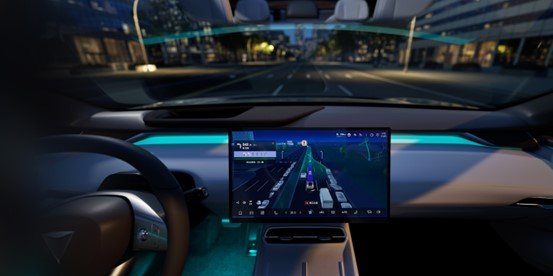
50-inch AR-HUD
This size basically belongs to the camp that "does away with traditional instruments":
key information is projected directly into the forward field of view, so you do not need to look down;
when doing AR navigation, turn arrows and lane lines can be overlaid on the road more intuitively.
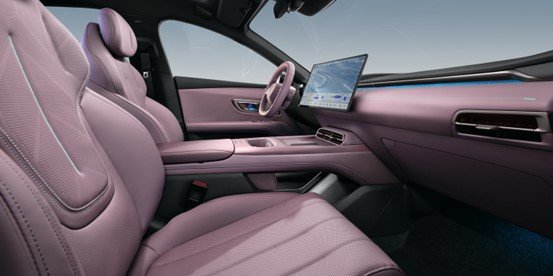
Together with the central control large screen + T-shaped central control layout, the entire cockpit logic leans toward the idea of "lifting key information to eye level and sinking unnecessary operations into the screen," so for people used to using smartphones, the adaptation cost will not be very high.
5. Space and range: "class-transcending" dimensions, range covering commuting + long trips
1. Body and passenger space
Length / width / height: 4830 / 1905 / 1480mm
Wheelbase: 2900mm
This size has steadily entered the mid-size car camp. In theory, rear legroom and lateral seating width will both be more generous than A-segment and A+-segment electric sedans. For users with family needs, this means:
adults in the rear seats will not feel too cramped;
with a child safety seat + one adult accompanying in the family, it is easier to arrange;
trunk depth and opening size are better suited for long-distance road trip loading.
2. Power and range
What the L06 has currently announced are the core data of the pure electric single-motor version:
Motor power: 200kW
Battery capacity: 56.12kWh / 68.82kWh
CLTC range: 560km / 670km
A simple conversion to usage scenarios:
Daily commuting + around the city: the 560km version is already enough. If you commute 40–50km per day, charging once a week should not be a problem.
Occasional long trips and self-driving tours: the 670km version will make it easier when planning charging stops, especially when there is some range loss in northern winters, a longer displayed range can give you a bit more psychological reassurance.
6. Who should consider the Deepal L06?
Considering its pricing, hardware, and orientation, I am more willing to understand the L06 as **"a mid-size pure electric sedan prepared for young families and users sensitive to driving feel"**, rather than simply a price-war contender.
Groups worth focusing on:
People with a budget between 130,000 and 160,000 yuan who originally planned to buy a compact electric sedan but also care about space and chassis quality;
People who have requirements for driving feel and body dynamics, and hope the car is not just "easy to drive" but also "a bit fun";
Users who value intelligent configuration, accept the pace of OTA evolution, and are willing to "upgrade and play" along with the car.
Points you need to test yourself and think through clearly:
whether the charging network and service capability are friendly to you in the cities/routes you commonly use;
whether your expectations for the brand and resale value can accept the combination of "new force + independent new technology";
no matter how the magnetorheological suspension is tuned, it is impossible to simultaneously achieve "completely soft" and "always stable." Whether you care more about comfort or support, it is best to take a test drive before making a judgment.


