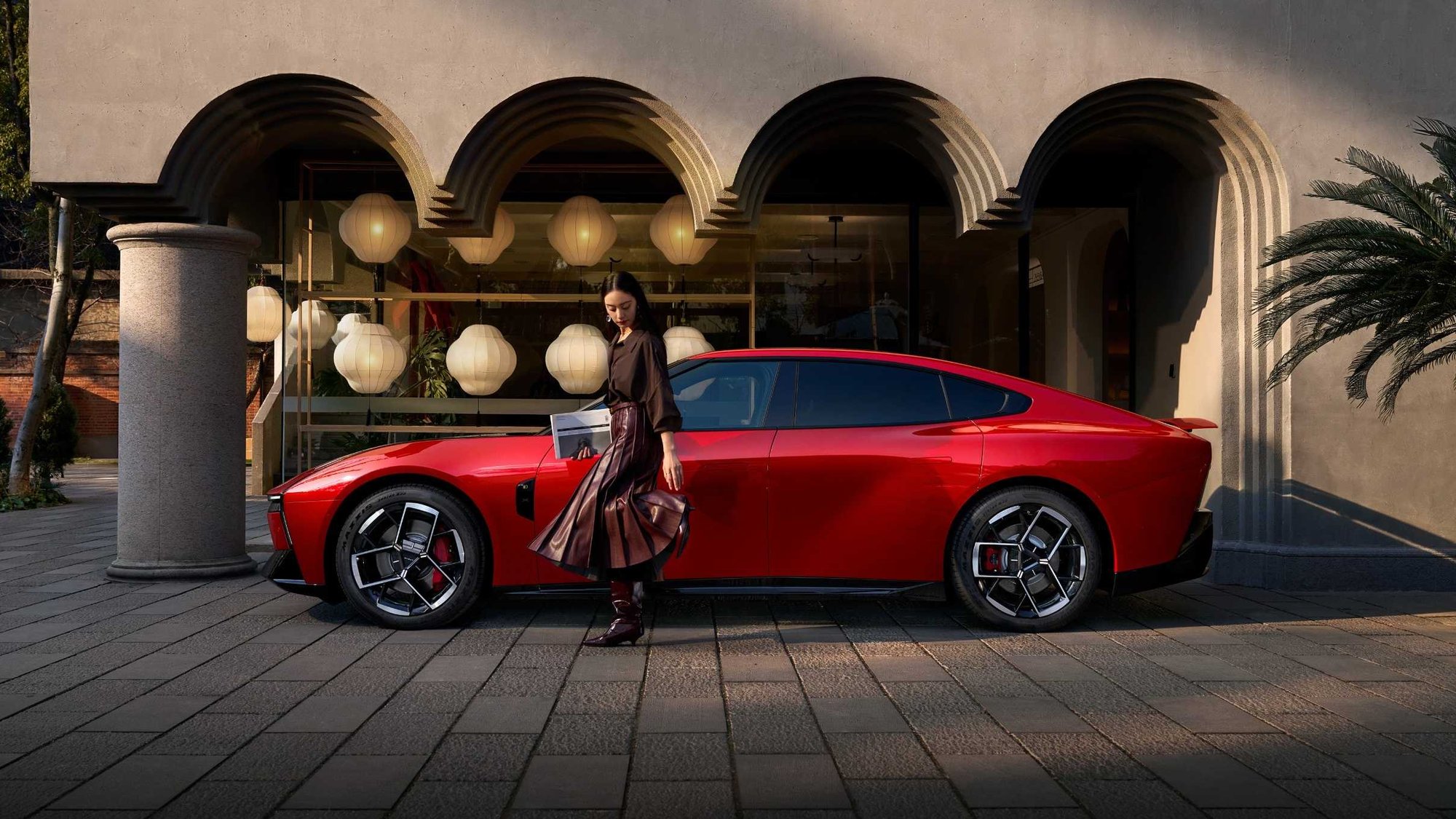
On March 18, the new version of the XPeng P7 was officially launched, with an official guide price range of 203,800 to 301,800 yuan. The four announced versions are the 702 Max, 820 Max, 750 AWD Max, and 750 AWD Wing Ultra. At the same time, XPeng also added two new version tiers, Max and Ultra SE. Among them, Ultra SE can be upgraded from Max for an additional 12,000 yuan to "2 Turing AI chips + second-generation VLA," while Ultra can be upgraded from Max for an additional 20,000 yuan to "3 Turing AI chips + second-generation VLA + VLM large model." From a product definition perspective, the core of this update is not simply adding new colors, but reorganizing the P7's technical path in intelligentization, powertrain performance, and product hierarchy.
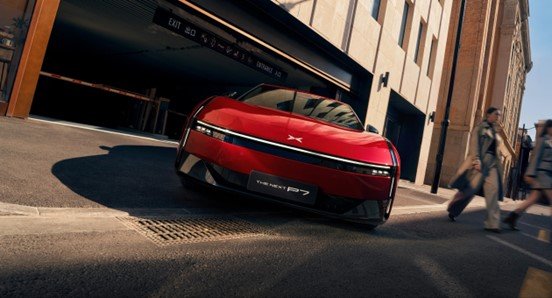
First, let's look at the body and aerodynamics. The XPeng P7 has body dimensions of 5017/1970/1427 mm and a wheelbase of 3008 mm, and the vehicle continues to maintain a low-slung, wide-body coupe proportion. The official figures also give a length-to-height ratio of 3.57, a width-to-height ratio of 1.40, and a wheel-to-height ratio of 0.52. These proportions show that it prioritized body stance at the design stage rather than simply maximizing space. More importantly, the new car's front fascia adopts a floating license plate bracket and hidden active grille shutter, while the rear adds an active retractable electric spoiler, and the vehicle's measured drag coefficient reaches Cd 0.201. The officials also stated that more than 25 aerodynamic optimization designs across the vehicle can bring a range gain of more than 90 km. In other words, the styling update of this generation of P7 is not just for a visual sense of sportiness, but is balancing styling, cooling needs, and range efficiency.
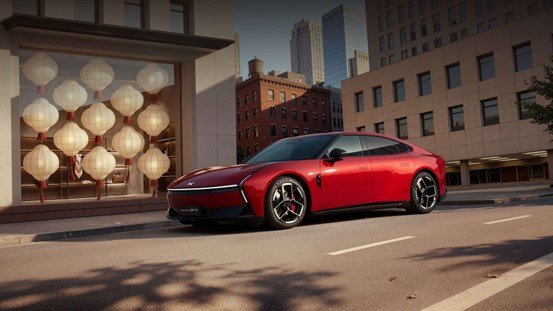
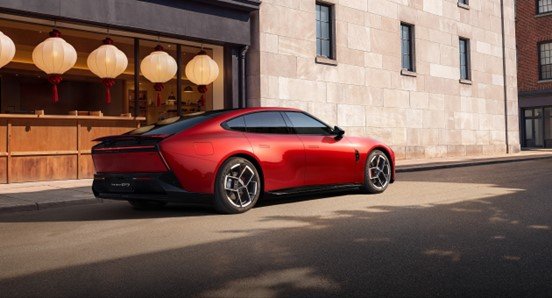
Among the exterior changes, the most visible are the three newly added exterior colors: Starlight Red, Night Black, and Nebula White. But from an engineering perspective, what is more noteworthy is that the new color options are not an isolated change, but are updated together with the vehicle's stance, wheels, and package logic. Especially for coupe products, color itself amplifies the expression of curved surfaces, light and shadow, and contour proportions, so it is not merely an aesthetic upgrade, but part of the completeness of the entire exterior design language. That is to say, XPeng is not just "giving the P7 a new skin," but using the new version to unify and calibrate body stance, aerodynamic design, and exterior identity.
Next, let's look at the cabin. The XPeng P7 this time adopts new interior colors such as Gravity Red, but more important than the color scheme is the change in the cockpit interaction architecture. The official product page shows that the new car is equipped with an 87-inch AR-HUD, a 15.6-inch three-axis灵动 central control screen, a sport instrument screen, and Touch Pad smart touch controls; the satellite knobs on the left and right sides of the steering wheel handle high-frequency functions such as driver assistance, suspension, Boost mode, and driving modes. From an ergonomics perspective, the goal of this setup is to reduce the cost of switching visual attention and operation paths while driving: high-frequency information moves up to the HUD, high-frequency functions move down to the steering wheel and door panel touch areas, and the central large screen takes on more of a comprehensive display and interaction hub role. Compared with piling all functions into one large screen, this layered interaction is closer to an engineering-oriented approach.
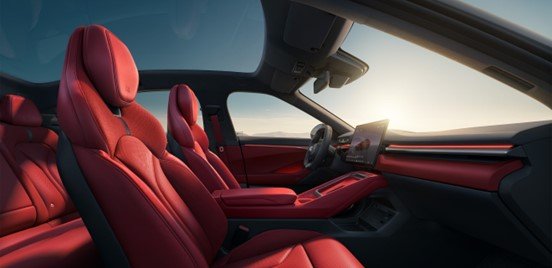
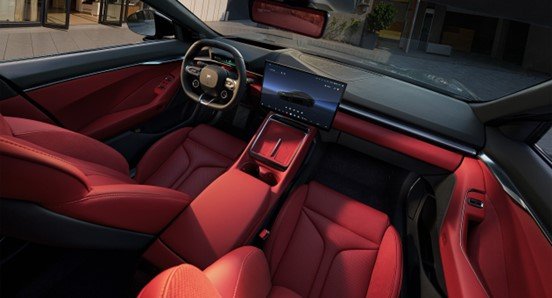
The seats and space are also not simply about stacking features. Official information shows that the new car adopts one-piece sport seats, with the driver's seat featuring active side bolsters, and materials using Nappa leather and Dinamica; it is also equipped with a 1.84-square-meter three-layer silver-coated panoramic roof, with official figures marking a UV blocking rate of 99.99% and an infrared blocking rate of 99.58%. For the rear row, it provides 120 mm of knee room, a 513 mm seat cushion length, and a 30° backrest angle, and adds an 8-inch rear entertainment screen. In terms of storage, the trunk volume is 575 L, the front trunk is 56 L, and after folding the rear seats it can expand to 1929 L. Taken together, these parameters show that the XPeng P7 does not completely sacrifice daily usability just to maintain low-slung coupe proportions. Its approach is more like making comfort and space utilization balanced enough under the premise of "driving stance first."

The real technical center of this upgrade is the intelligent system. Officially disclosed, the XPeng P7 is equipped with the second-generation VLA, can be equipped with up to 3 Turing AI chips, has 2250 TOPS of effective computing power, and supports an on-vehicle VLM large model. The product page also gives two key statements: first, the second-generation VLA improves model inference efficiency by 12 times; second, model parameters are increased by 10 times compared with mainstream industry solutions. Even without discussing the specific algorithm route in detail, these two indicators show that XPeng wants to advance intelligent driving from "a rule-driven collection of functions" to "stronger model-driven system capability." This is also why the official release repeatedly emphasizes that the second-generation VLA is not a single-point feature upgrade, but an expansion of capability around highly complex scenarios such as complex roads, irregular vehicles, accident detours, nighttime yielding, and un-navigated small roads.
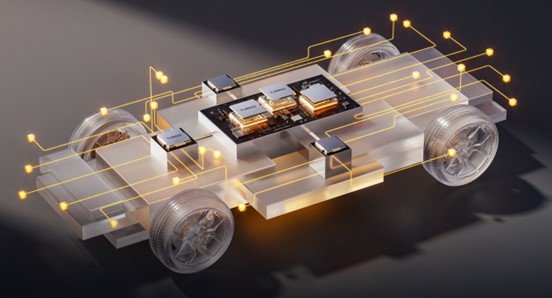
From a version strategy perspective, XPeng has delivered intelligent capability in tiers this time. Ultra and Ultra SE are the first to carry the second-generation VLA, while the Max version supports later upgrades. The engineering logic of this approach is very clear: first use higher hardware specifications to validate and unleash model capability, then roll it out to a larger scale of users through a unified platform. If understood from the perspective of the vehicle's electrical and electronic architecture, this means that the P7 this time is not just stacking computing power on one version, but has already reserved space at the product level in advance for subsequent feature openings. For users, this is more extensible than the traditional logic of "only by buying the top trim can you permanently have the complete experience."
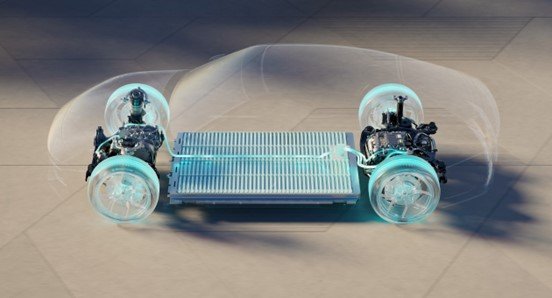
For the powertrain, the new car is built on an 800V high-voltage platform and offers both rear-wheel drive and dual-motor all-wheel drive layouts. Official materials show that the rear-wheel-drive version has a maximum power of 270 kW, the all-wheel-drive version has a maximum horsepower of 593, accelerates from 0 to 100 km/h in 3.7 seconds, and has a top speed of 230 km/h. For the battery, two options are provided, 74.9 kWh and 92.2 kWh, corresponding to CLTC range coverage of 702 km, 750 km, and 820 km.
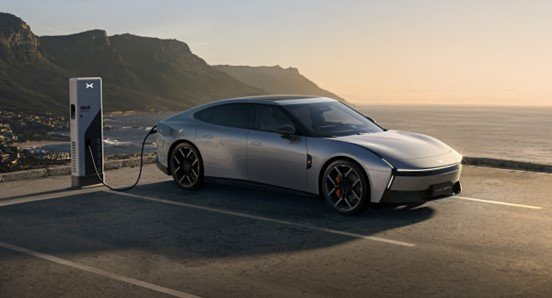
In terms of charging efficiency, the official figure is a maximum replenishment of 525 km in 10 minutes of charging. Putting these figures together, the focus of the XPeng P7's powertrain this time is not extreme performance, but using the 800V platform to accomplish three things as much as possible within one system: high power output, long range, and high charging efficiency. What it aims to solve is not being strongest in a single operating condition, but achieving higher efficiency across the vehicle's full range of scenarios.
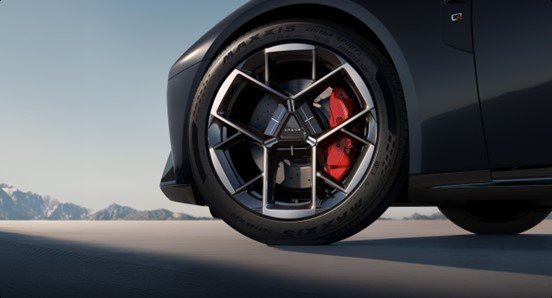
The official product page shows that the XPeng P7 adopts a supercar-level mid-mounted electric drive layout, with a 50:50 front-to-rear weight distribution and an 81% mass ratio between the axles; the suspension structure is an all-aluminum front double wishbone and rear five-link independent suspension, and it is equipped with dual-chamber air suspension. The air springs support height adjustment from -20 mm to +30 mm, air spring stiffness can be adjusted between 100% and 140%, and damper damping can be adjusted 1000 times per second. Combined with official data such as a 100-0 km/h braking distance of 33.16 m and a Zhejiang Circuit lap time of 1:38.767, it can be seen that XPeng has not made the P7 into an electric coupe that only emphasizes straight-line acceleration, but has simultaneously carried out systematic development in steering response, body support, center-of-gravity control, and braking stability. For engineers, this demonstrates chassis maturity more than looking at 0-100 km/h acceleration alone.
If this new version of the XPeng P7 is broken down into several engineering questions, it is roughly answering three things. First, how to continue reducing drag and improving range while maintaining coupe proportions; second, how to truly fit stronger model capability into a mass-production car and achieve scalable delivery through version tiers; third, how to establish sufficiently balanced dynamic capability among the 800V system, electric drive, suspension, and braking system. Based on currently public information, the direction of the XPeng P7's update this time is clear: it is not an emotional facelift, but a systematic optimization centered on vehicle efficiency, electronic architecture, and dynamic performance.
Conclusion: What is most worth watching about this P7 is not that it is "redder" or "better looking," but that it has begun to re-establish the connection among the three main lines that a pure electric coupe should have - aerodynamic efficiency, intelligent system capability, and chassis dynamic quality - within the same product logic. For the 200,000 to 300,000 yuan pure electric coupe market, this is more meaningful than a single-point upgrade.


