Hidden door handles are banned, zero-gravity driving mode is prohibited, and life-saving buttons must be physical. This draft for public comment from the Ministry of Industry and Information Technology has tapped the brakes on "speed."
Many people have had this experience when visiting a showroom.

The salesperson stands by the car, raises a hand, and the door handle pops out on its own. Press a button and the seat lies flat—they call it zero gravity. The center screen covers almost the entire dashboard. It all looks impressive.
But have you ever asked: before these features were installed in the car, how many times were they actually verified, and who ultimately signed off on them for you?
On October 10, the Ministry of Industry and Information Technology, together with the Ministry of Public Security, the Ministry of Ecology and Environment, and the State Administration for Market Regulation, released a draft for public comment.
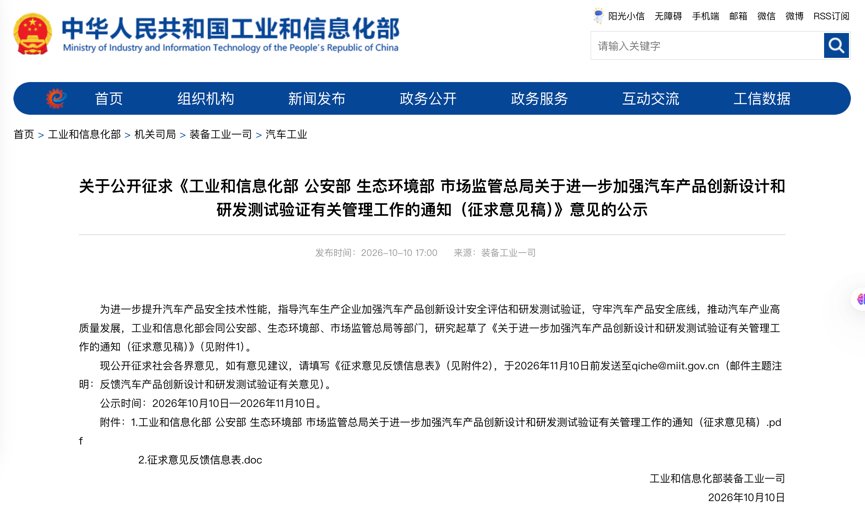
The title is very long—it's about strengthening the management of innovative design and R&D testing verification for automotive products.
The title is convoluted, but the content is very practical:
Fully hidden door handles are banned
Using zero-gravity seats, rotating seats, or folding seats into beds while driving is banned
Life-saving buttons for emergency escape, emergency braking, and power cutoff must return to physical form
Marketing rhetoric can no longer be spouted off the cuff
Once the news came out, voices on both sides were loud. One side said the regulation is good; the other worried it goes too far and suppresses the innovative momentum that Chinese automakers have fought so hard to build.
Let's discuss three questions: What exactly does it regulate, why did it act at this particular time, and are technological progress and policy truly inherently opposed?
One, what it regulates can be explained in one sentence
Innovation is fine, but putting it on the road without verification is not.
Translating the most striking requirements in the document into plain language, it comes down to a few things.
Life-saving buttons must be touchable. Emergency escape, emergency braking, and drive system power cutoff devices must have physical buttons with prominent labeling. Functions used daily—lights, wipers, defrosting and defogging—must retain a physical control even if touch or pressure-sensitive controls are also used.

The reason isn't complicated: when the screen freezes or the system fails, the driver must not be left fumbling on a black screen unable to find the light switch.
Fully hidden door handles are directly banned. The document requires that innovative door handle designs must have mechanical redundancy and must leave room for hand operation. In other words, when power is cut or a collision occurs, the door must be openable by purely mechanical means.

This wording is among the heaviest in the entire document, because the cost is not hypothetical.
Just in August of this year, the State Administration for Market Regulation issued 9 recall announcements in a single day, with 9 automakers filing simultaneously, involving over 4.27 million vehicles—the largest batch of recalls in China triggered by a single issue. The cause was highly consistent: interior emergency mechanical handles were too similar in color to the interior trim, making them nearly invisible in normal conditions and affecting escape and rescue in extreme situations.

Here's a number worth remembering: CIRI crash tests show that for vehicles equipped with electronic door handles, the door pop-out success rate after a side collision is only 67%, compared to 98% for traditional mechanical door handles.
Those critical few seconds are the distance between life and death.
Zero-gravity seats, rotating seats, and folding seats into beds cannot be used while driving. Note the document's exact wording: "limit usage scenarios through technical means." It's not about reminding through the manual, not about warning through a pop-up on the car's system—it's about designing it so you simply can't use them while driving.
Why is it so strict? When a person is lying flat, the seatbelt basically can't hold them, and the body has no restraint in a collision. That comfort is bought with safety.

Large screens aren't banned—but you have to prove they're safe first. Center entertainment screens, large-area displays, and complex head-up displays must be evaluated for whether information presentation interferes with driving, whether they're reliable in extreme environments, and must pass crash safety assessments. Foldable screens and flexible screens are explicitly not allowed.
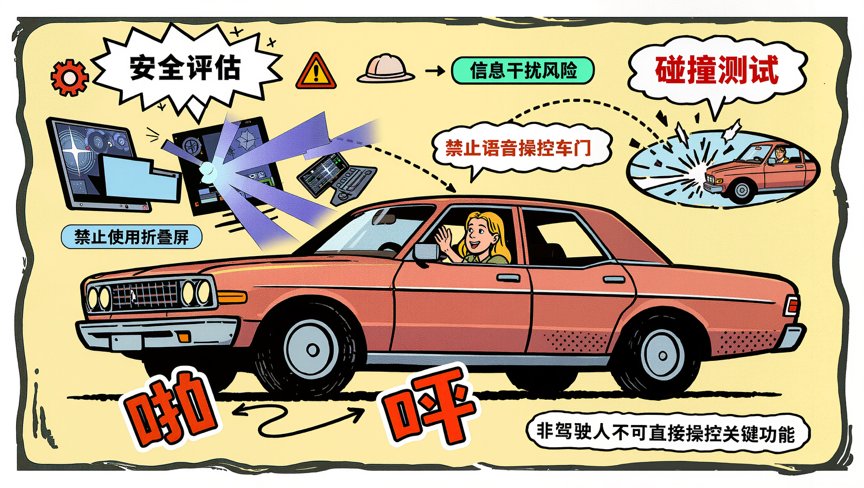
New interactions like voice and gestures cannot be given unchecked authority. During driving, non-drivers must not be able to directly control critical functions like wipers or door opening/closing through voice. A passenger saying "open the door" and the door opening—that's not appropriate.
Marketing can no longer exaggerate. False, exaggerated, or misleading advertising is prohibited; demonstrating product features in scenarios that violate traffic regulations is prohibited; inducing drivers to neglect safety responsibilities is prohibited.
Verification thresholds have also been raised across the board: reliability verification for new vehicles must be no less than 30,000 kilometers, environmental adaptability verification no less than 1 year, covering "two winters and one summer," covering all key configurations, with verification materials retained for no less than 6 years. Those with insufficient verification cannot obtain type approval and therefore cannot go on the market.

Two time points: Starting January 1, 2027, newly declared vehicle models involving innovative designs must add technical parameter filings; before July 1, 2027, already-marketed relevant models must supplement parameters and verification materials, and those with safety hazards after the deadline will be discontinued and recalled.
As usual, a reminder: this is still a draft for public comment, with the comment period running until November 10, 2026, and anyone can submit opinions. But the direction has already been set.
Two, why act now—because "speed" is starting to cause problems
To understand this document, we first need to look at what has happened in the industry in recent years.
China's auto industry has gotten to where it is today by relying on one word: speed. Switching lanes through electrification, overtaking through intelligentization, applying the strongest hardware supply chains and internet-style playbooks to car-making—this is real capability, and there's no denying it.
But speed has another side.
In the past, developing a car involved a full verification cycle of three to five years; now, some models have compressed this to just over a year. Some tests are replaced by simulation instead of real-vehicle road testing, extreme-condition testing becomes a photo op for promotional materials, and experiments that should be done are skipped.
The result is a very subtle change: consumers' identity has shifted from users to beta testers.

Many features aren't verified before being handed to you—they're sold to you first, and then real road conditions and real accidents help complete the verification.
This can't be entirely blamed on automakers. The industry atmosphere is like this: if you're not fast, your competitor is; if you verify for three months, your competitor has already been on the market for three months. The market votes with its feet, and no one dares to slow down. Once this race takes shape, the first thing sacrificed is often the verification step.
So when policy acts at this moment, it's essentially tapping the brakes on this race—and it's a brake with rules: you can continue to be fast, but the safety verification process cannot be skipped.
There's another account that's less often mentioned.
When a phone freezes, just restart it; when an app crashes, fix it in the next version. Cars are not like that. Two tons of metal traveling at 120 km/h on a highway—any "small bug" could be an irreversible collision.
The logic of phones is fast iteration, high fault tolerance, users as testers. The logic of industrial products is slow verification, low fault tolerance, finalized at factory.

Neither logic is inherently right or wrong; the difference lies only in assumptions about "how much a single failure costs." Anyone who applies consumer electronics' fault-tolerance expectations to industrial products will ultimately be bitten back in real-world scenarios.
And this backlash is delayed: features become popular first, accidents appear sporadically, public opinion slowly turns, and finally overall trust declines. By the time the public's attitude toward the word "technology" slides from blind faith to aversion, it's not just one company that gets hurt—it's the innovation credit the entire industry has accumulated over these years.
Between worship and loathing, there is no buffer zone.

Three, are technological progress and policy truly a contradiction
The opposing voices have a point: when seatbelts, airbags, ABS, and ESP first came out, they were all new things, and all were debated. If there had been a blanket ban back then, where would today's standard equipment come from? If policy regulates too tightly, will it regulate away innovative vitality?
The supporting voices also have a point: consumers have no obligation to conduct safety experiments on behalf of automakers.
Both sides are half right. But looking at this document calmly, it has a key design—it regulates "putting on the road without verification," not "innovation" itself.

The words that appear repeatedly in the document are assessment and verification, not prohibition of innovation. Zero-gravity seats aren't banned—they just can't be used while driving; door handles aren't banned from innovation—only fully hidden ones are not allowed. The boundaries are drawn very specifically, and the space left is not small.
Even more noteworthy is the phrase "dynamic update mechanism" in the document: MIIT will continuously track industry innovative design developments and dynamically adjust technical guidelines based on industrial application and standard revision conditions.
Translated, this means standards themselves must have an update cycle and can no longer follow a pace of revision every few years. The old model of "technology running by the month, standards chasing by the year" is itself no longer sustainable. Standards are only meaningful if they can keep up; if they can't, they're left with only the function of post-hoc accountability.
Another arrangement also illustrates the point: existing products are given until mid-2027 to supplement materials—strict for new entrants, a transition period for existing ones. This isn't flipping the table and starting over; it's leaving a window for self-correction.

So the "technology vs. policy" opposition is very likely a false proposition in itself. The real opposition worth discussing is marketing rhetoric running faster than technical capability.
Technology is not wrong; interpreting the courage to innovate as taking a gamble and using consumer safety as the cost of trial and error—that is the problem.
Four, for ordinary people, it comes down to three things
First, when buying a car in the future, the probability of stepping into a trap will be somewhat lower.
In the past few years, many "new features" were actually features "launched without sufficient verification," and you were paying for them with real money. After the document takes effect, automakers will have to show you safety proof first.
Second, your criteria for judging a car can be clearer.
If a salesperson brags about zero-gravity seats again, you can ask: can it be used while driving? Under the new rules, no.
If they brag about how premium hidden door handles are again, you can think: in a critical moment, can it open? Physical door handles aren't unsophisticated—they're a life-saving design.
If they brag about the big screen again, you can ask: has reliability verification under extreme conditions been done? This question will most likely stump them.
Third, marketing rhetoric will be reined in, information will become more truthful, and your chances of being misled will be fewer.
But don't celebrate too early. A draft for public comment is still a long way from implementation—it has to go through public comment, revision and finalization, official release, and enforcement supervision, and every step has variables.
Moreover, policy can draw boundaries but cannot draw human hearts. Whether automakers are willing to spend real money on verification, and whether consumers are willing to pay a bit more for "verified innovation"—that's what's truly worth watching next.
Technological progress actually doesn't need to fear policy. True innovation—policy can't stop it; unverified innovation—policy shouldn't let it slide either.
China's auto industry has proven over these years that it can run fast. What comes next is whether it can also run steadily—and running steadily has never meant not running, but rather taking each step firmly before running.

For ordinary people, remembering one sentence may be enough:
Ask one more question: has this feature been verified?
That one question is more useful than any spec sheet.


