Today's topic—we're not just talking about cars, but also taking a detour into home appliances.
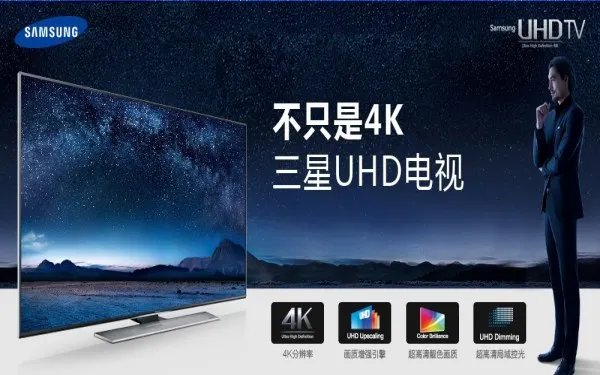
Recently, Samsung TVs have quietly exited China's home appliance retail market. In the first four months of 2026, Samsung's online share of color TVs was only 1.33%, and offline just 3.54%, with annual shipments shrinking from a peak of 2.55 million units to fewer than 500,000.
Almost simultaneously, Hyundai and Kia's combined monthly sales in China fell below 10,000 units, leaving them with just 0.6% market share. Two representatives of Korean consumer electronics and automobiles have reached a similar mark in the Chinese market.
So a familiar narrative quickly heated up in public discourse: Korean brands are receding, domestic brands are taking over, and the TV industry is replaying the breakout script of new energy vehicles. Hisense and TCL's specs in the Mini LED race are already "grinding Sony into the ground," and Samsung's today is Sony and LG's tomorrow.
This judgment is half right. It is a fact that domestic TVs have caught up in hardware and even overtaken in some areas; but equating TV premiumization with the "lane-changing碾压" of new energy vehicles underestimates the industry's most stubborn threshold.
On the hardware ledger, domestic brands have indeed caught up
If you look only at spec sheets and supply chain depth, domestic high-end TVs today have far more confidence than they did five years ago.
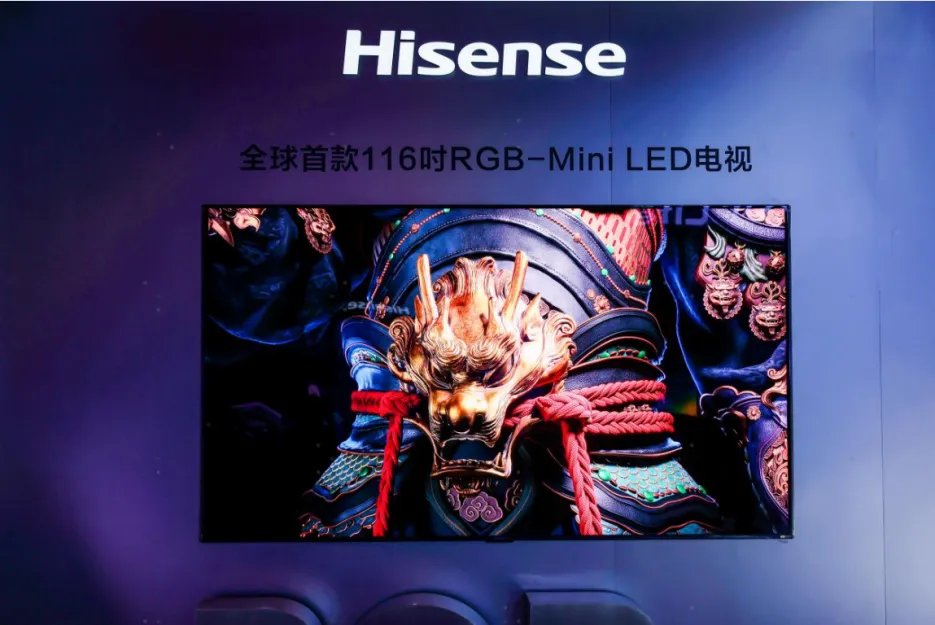
In the domestic high-end color TV market, the sales share of Chinese brands is already 2 to 3 times that of foreign brands; in the global high-end TV market, Hisense plus TCL's combined share has risen to 39%, just one step away from Samsung plus LG's just over 40%. Hisense was first to mass-produce RGB Mini LED, a full year ahead of Sony's planned launch; TCL's SQD Mini LED directly benchmarks Sony Bravia 9 and LG G5 in peak brightness and color gamut coverage. The domestic panel localization rate exceeds 60%, and the integrated chain of chips, backlights, and complete-set manufacturing is in their own hands, with an iteration speed that foreign brands find hard to match.
In other words, when it comes to "what materials can be used and how many can be stacked," domestic high-end brands no longer need to look up to Sony and LG. For Mini LED TVs of the same size and zone count, Sony's pricing is typically 30% to 50% higher than Hisense and TCL, while its on-paper hardware specs may not even be superior.
But that thin "window paper" is precisely why high-end is high-end
The problem lies beyond the specs.
The Sony X95L's backlight zone count looks "pitifully" low next to domestic flagships, yet in foreign media reviews its halo control outperforms Samsung's contemporaneous models, and the Bravia 9's black performance is described as "close to OLED." The reason isn't the number of LED beads, but the XR chip's judgment of画面 focal points, its simulation of depth-of-field relationships, and the deep meshing between the backlight scheduling system and picture quality algorithms. Sony's XR chip does "cross-element collaborative decision-making": it first determines where the human eye will look, then makes color, contrast, and clarity work together around that focal point, rather than breaking each metric apart and optimizing them separately.
Domestic chip progress is real and tangible. Hisense's Xinxin H7 achieves simultaneous light and color control, and TCL's TSR AI continues to iterate on cloud-plus-device dual enhancement, but the core logic still leans toward "processing each local area better." In focal point detection and cross-element collaboration, the gap with Sony cannot be closed in the short term by stacking computing power. A more intuitive indicator is backlight response latency: some domestic models' local dimming response is twice as slow as the LG C3, making visible halo trailing easy to spot in motion scenes. The zone count can double overnight, but the scheduling ability—"each LED bead knows when to light up, how much to shine, and when to turn off"—requires algorithms and time to cultivate.
LG represents another kind of barrier. Its monopoly position in OLED self-emissive panels means "pure black" and "infinite contrast" remain advantages the LCD camp cannot fully erase with zone counts. Domestic high-end brands are chasing hard in the Mini LED lane, but in the OLED branch, LG still holds the power of definition.
Are Sony and LG's premiums still worth paying for now
The answer depends on what you're actually buying when you buy a TV.
Sony's premium doesn't buy specs—it buys "no fuss." With the same source material, Sony's XR chip can process dark details and character outlines so that they look "comfortable without adjustment," and its motion compensation trailing control remains industry-leading. For consumers who don't want to study zone counts, peak brightness, or color gamut coverage and just want to turn on the TV and see the "right" picture, this premium has real substance. LG's premium falls more on the physical advantages of the OLED panel itself, and the irreplaceability of the self-emissive approach in dark-room viewing scenarios.
But the premium is thinning. Sony's J series has frequently had no-sound failures and been listed on complaint platforms' blacklists, and flagship models failing right after warranty expiration are eroding the faith foundation of "Sony大法." Samsung's exit has already proven that when China's supply chain erases the technology gap and when young consumers' tolerance for brand premiums approaches zero, the "foreign halo" itself no longer constitutes a reason to buy. Korean cars demonstrated the same logic even earlier: the once niche positioning of "cheaper than Japanese, more premium than domestic" was filled overnight by domestic brands with "electricity cheaper than oil," and by the time brand perception solidifies into "cheap and outdated," it's too late to pull back.-26-27
How should ordinary consumers actually choose
If your first priority in buying a TV is large-screen immersion and "getting more for the same money," domestic high-end is the more rational choice right now. For Mini LED above 85 inches, the configurations Hisense and TCL offer in zone count, peak brightness, and anti-reflective screens are basically unavailable from Sony and LG at the same price. The integrated panel and complete-set supply chain means a faster iteration pace—the flagship you buy this year won't be backstabbed too hard by your own mid-range products next year.
If your criteria for judging picture quality are "skin tone accuracy, dark-scene layering, and motion smoothness when watching Blu-ray originals in a dark room," and you're unwilling to spend time tuning parameters, Sony's XR chip models remain the worry-free answer. But you must accept two premises: hardware specs are not superior, and the price is noticeably higher. Low-end Sony isn't worth touching—that's paying purely for the logo.
If you're a diehard OLED fan pursuing pixel-level light control and infinite contrast, LG remains the first choice in this niche lane. Domestic brands' presence in OLED won't change this landscape in the short term.
What domestic high-end needs isn't "replication," but "positional warfare"
New energy vehicles' replacement of fuel vehicles happened on an incremental track: penetration surged from single digits to over 50%, the pie was growing, and every bite early movers took was new. TVs are not. The industry's overall stock is shrinking, replacement cycles are measured in years, and consumers won't replace the TV at home that still works just because "domestic brands have risen." This means domestic high-end cannot complete the replacement of foreign brands at the speed of new energy vehicles' "overturning the table in a year or two."
Samsung's "exit" is not a defeat either, but a strategic contraction after doing the math: the profit from selling one TV is less than a fraction of a memory chip's, so it cut unprofitable terminal retail and doubled down on semiconductors and high-end manufacturing—it simply changed posture to stay at the table. Sony is the same: its contraction is a voluntary abandonment of scale to defend the profit high ground of picture quality tuning and content ecosystem.
So what domestic TVs truly need to fight is not a quick annihilation battle relying on spec sheets and price wars, but a positional war to build "picture quality certainty" and "brand trust" inch by inch at every price segment and every usage scenario. Catching up in hardware took five years; catching up in algorithm tuning and brand mindshare may take longer. The good news is that the window paper has already been pierced with cracks; the bad news is that breaking through the final layer depends precisely not on stacking materials.